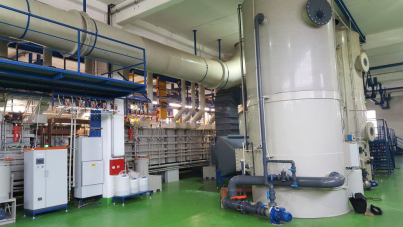
An air purifier from the electroplating plant was supplied. Scrubber 1. removes chromium and chromium compounds from the air.
Scrubber 2 will remove nitric oxide compounds NO and NO2, commonly referred to as NOx, from the air. Each sector has its own separate ventilation system.
At the end of the ventilation system, there is a droplet separator, and on some lines there is also a scrubber for additional chemical air purification.
Air extraction is not performed above all tubs, above the rinsing tub no air extraction is performed. With the bath for electrolysis, air is sucked out with the quantities of air per m2.
Chromium and chromium compounds are removed from the air by rinsing the air with water in a Scrubber 1. Water is recirculated through a filling of PALL rings and collected in a tank at the bottom of the scrubber. The water is supplemented with fresh water to saturate the air with water vapor and dilute the solution so that the proportion of chromium in the water is in the limit.
Excess chromium solution and chromium compounds go to the overflow and is disposed of with other chromium compounds intended for disposal.
Automatic process control is performed by controlling the level of recirculation solution in the tank at the bottom of the scrubber, measuring the electrical conductivity of the solution, and dosing water as a function of temperature and humidity at the inlet to the scrubber 1.
Nitrogen oxides from air in small concentrations can also be removed by washing with water. However, their removal by chemical processes must also be taken into account. As a rule, hydrogen peroxide, H2O2, in acidic or alkaline medium is used for their oxidation.
By the process of removing nitrogen oxides, the concentration of nitric acid in the recirculation solution is gradually increased. The recirculation solution is therefore gradually diluted, and the excess solution goes to overflow and further disposal as part of other chemicals used in galvanization.
Automatic process control is performed by controlling the level of recirculation solution in the tank at the bottom of the scrubber, measuring the electrical conductivity and redox potential of the solution, and dosing water as a function of temperature and humidity at the inlet to the scrubber 2.